By TAN CHENG LI
Photos by WONG SIEW TE
The Star, 8 Aug 2006
The world’s smallest bear, the Malayan sun bear, faces a not-so-sunny future as its natural habitat is fast diminishing and trails left by loggers open the way for hunters who covet its body parts.
BEAR #102 is a regular visitor at the base camp of Infapro, a forest regeneration project at the Ulu Segama forest in Sabah. Under the cloak of darkness, he would turn over rubbish bins, even break into staff quarters, in search of a meal.
His other popular haunt is the field centre of the Danum Valley Conservation Area close by, where he has been caught feasting on canned food and bottled chillie sauce, among other things.
The antics of #102, a healthy male Malayan sun bear weighing 56kg, has been closely watched by wildlife researcher Wong Siew Te, who has trapped and radio-collared the animal. Wong named the bear what else but, Infapro.

A Malayan sun bear tearing a log apart to feast on termites found within. The only bear species found in Malaysia, sun bears are the least studied of the world’s eight bear species.
Infapro is testimony to the fact that when civilization encroaches into the wilds – animals start invading pantries instead of foraging for jungle edibles. Infapro is also “trap-happy”, having been recaptured twice. Bears learn fast. Infapro knows that once trapped, he would not only get food and be released but also gets a special treat, honey, which Wong uses to calm trapped bears.
Wong is pursuing a three-year doctorate project on the effects of selective logging on the species and bearded pigs. “By monitoring signals sent out by the radio collars, I can locate and track the bears to find out their habitat and home range, what they eat and what they do the whole day,” says the student of University of Montana, United States.
He captured three bears within a week in September last year but these days, he finds other animals, civet cats, in particular, in the traps. Remote-sensing automatic cameras (or camera traps) reveal three other bears but these have ignored the baits.
The other radio-collared bear is #103 or Bruno, a 45kg male. Locating and tracking Bruno has been difficult as he seldom strays from his rugged forested home, unlike Infapro who prefers the easier route – dirt roads.
Over two hours’ drive from Lahad Datu, Wong’s project site covers the virgin Danum Valley Conservation Area and the logged Ulu Segama forest reserve next door. From 1998 to 2000, while studying the ecology of sun bears there for his Masters degree, he had radio-collared six bears and gained much insight into the mammal, which is the least studied of the world’s eight bear species.
“I call Malayan sun bears the forgotten bear species,” says Wong, 37. “It is Malaysia’s only bear species but get so little attention.”
With so little known about the species, its conservation status is uncertain and the IUCN (World Conservation Union) has classified it as “data deficient”.
But Wong fears that sun bears are endangered as they are highly dependent on forests, which are fast diminishing. “No one knows their population but one thing we do know is that they number fewer than orangutans. So if orangutans are endangered, sun bears are even more endangered.”
In fact, the low trapping success at Danum hints at a sparse population. Another ominous sign – Wong has not encountered any of his previously radio-collared bears. He does not know why but thoughts of hunters at work never strayed from his mind.
Though a protected species, sun bears are still poached for their meat, paws and gall bladders, which purportedly have health benefits. Natives, in the past, wear bear claws and canines to drive away evil spirits.
Famine in the forest Sun bear survival hangs on intact forests for as the green cover thins, so does food supply. Logging, says Wong, not only removes tall trees which bears sleep in but also damages the figs and oaks which feed them. Logging roads also create convenient access for poachers.
Contrary to popular belief, food is not always abundant in the moist tropical jungle. “The rainforest is a harsh environment. Forest production is low except during mass fruiting season and small sporadic fruiting in between,” says Wong.

His previous study documented a famine in Ulu Segama. Much to his misery, he found eight sun bears and many bearded pigs which were all skin and bones. Two radio-collared bears later died from starvation.
Named for the golden or white ‘U’ shape patch on their chests, sun bears are otherwise all black with smooth, short fur.
Wong believes weather changes, and habitat changes brought on by logging, had altered fruiting cycles and eventually led to the famine. He fears the impact of a future famine.
Now we protect sun bears only on paper. Policing against hunters and illegal trade in bear parts is poor, as are surveys on sun bear distribution and population. Wong says the lack of knowledge hinders conservation efforts.
To plug the information gap, he will embark on a year-long project to map sun bear distribution in the country. This will pinpoint areas of conservation priorities.
Other hurdles are public ignorance and the problem of captive bears. Sun bears are popular zoo exhibits but they really do not belong in a cramped artificial environment, being creative and exploratory by nature.
Cute and cuddly cubs kept as pets quickly outgrow their appeal and are conveniently surrendered to wildlife authorities. Captive bears cannot fend for themselves in the wild and in Sabah, many end up at Sepilok Orang Utan Rehabilitation Centre in Sandakan – simply because the facility has cages to spare.
Visits to Sepilok often leaves Wong depressed as he sees bears pacing in tiny cages, shaking their heads. Bent on improving the bears’ living conditions, he has raised funds to build a recreation pen with climbing structures for the 11 bears there.
But another 20 bears remain caged in deplorable facilities in zoos and private parks in the state but cannot be seized as Sepilok no longer has room. Lacking a place to house captive sun bears, Sabah Wildlife Department in 2004 released 10 individuals into Deramakot forest reserve but there are no checks on their survival. It also sent 10 bears to American zoos in 1996 and again in 2000.
To shelter captive and displaced bears, Wong has proposed a sun bear sanctuary at Tabin Wildlife Reserve, 50km from Lahad Datu. Talks have gone on for three years but funds fell short.
Like many overlooked species, sun bears compete for conservation attention with species such as the Sumatran rhinoceros, Malayan tigers, Asian elephants and orangutans.
But with their home seized by loggers and planters, and hunters after their body parts, sun bears face a bleak future and surely, deserve more conservation care.

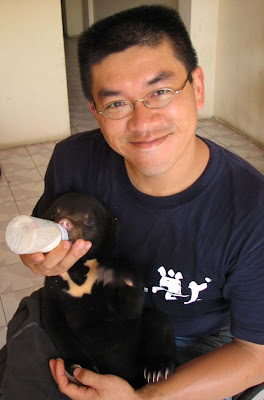
 If these baby bears can past the crucial infant stage where extensive cares was needed, they could pretty much make it to adulthood without any problem. However, more suffering once they grew bigger and stronger. By a year old, they could reached 15 kg, and were no longer safe pets to their human owners. Their strength grew, together with the tools that they used to find food: claws and canines, which could potentially did a lot of damage, if they wanted to. Depending on where were them kept and who kept them, they could be locked in small metal cages, sometime as small as 1m x 1.5m x 1.5m. In places like mini zoo or private menageries, they were usually kept in slightly larger cages with cement floor. One thing for sure is that these bears will never had a chance to feel soil, use their claws to dig, or their canine to bite (I will write more about how a wild sun bear live in the wild later).

 Most people who live in the countries where sun bears are found have no idea what is animal welfare about. In their dictionary, there is no such terms like “animal rights”, nor “animal welfare.” They do not think that the animals also have feeling, emotion, dignity, and can feel pain like a human being. What most people think about most animals is that they are here to serve us. As a result, bear owners do not feel it is wrong to cage a magnificent wildlife like a sun bear in a small cage. They think that as long as they feed the bear, and the bear stay alive, they are doing a very good job on “TAKING CARE” of the bears.


 Because they are small and cute, sun bear owner often keep them in a small pet cage for puppies or birds. This is the beginning of life in hell.
 I once saw a bear cub in a crocodile farm in Sarawak. From a distant he looked like a puppy because she was place next to a puppy. But from my distance, she did not look like a puppy because she paced none stopped. Puppy rarely paced, but sun bear pace all the time in captivity. Her condition was a typical bear cub in captivity: malnutrition with very pale color coat, weak, dehydration, stress, and extremely nervous. I immediately put my finger into her month to let her suckle.

 Solitary captive bears suck on pretty much any body part that they can get hold of: hand, feet, even their own penis, vulva, or other bears’ ears, if they have a companion to stay with. They will admit a series of “ummmmmmm..” sound with their eyes half closed when suckle. This is pretty much the first thing I do when I approached a nervous captive bear cubs, let them suckle, they then will calm down quickly and slowly trusting me.
 Like other animals, infant sun bears are very fragile creatures that need lots of care, attention, and nutrition. In captivity under human care, they usually receive very little of these essential elements, not to mention TLC that their mother use to give them. Unknown number of cubs died due to improper care, simply because of these so call bear owners do not have a clue how to take care and what to feed to baby bears. Many of them were given sweet condense milk, high fruity diet like lots of papaya and banana because they are cheap. Because of imbalance diet, many sun bear babies in captivities show signs of malnutrition and unhealthy. They did not have sleek black coat, but in stead, their hairs are sparse, dull, and pale color. Many of the cubs that looks like this will not live long.